

Dr Sanchika Campbell
Research Associate, UKRI Population Health Improvement (PHI-UK), Population Mental Health Consortium
Contact details
Biography
Sanchika is a Research Associate in UKRI Population Health Improvement (PHI-UK), Population Mental Health Consortium (PMHC), a national partnership of researchers, local government, voluntary organisations and people with lived experience focused on addressing the root causes of mental health inequalities. She is based in the Department of Psychological Medicine at the Institute of Psychiatry, Psychology & Neuroscience.
She joined King’s College London in 2013 and has been part of the Health Inequalities Research Group since, which has shaped her interest in participatory and community-engaged research. Her work focuses on community-based participatory approaches, the intersections of religion, spirituality and mental health, and reducing health inequalities.
Sanchika has recently been awarded funding from the King’s Population Health Institute (KPHI) for a public engagement project exploring the priorities of community members from racially minoritised groups around financial wellbeing education initiatives and health.
Sanchika completed her ESRC-funded PhD, the Perspectives on Religion and Spirituality in Coping with Mental Health (PRiSM) project (https://www.kcl.ac.uk/prism), supervised by Professor Stephani Hatch and Dr Charlotte Woodhead. Her research, nested within the Marginalised Communities programme at the Centre for Society & Mental Health, explored how religion and spirituality shape mental health, coping, and help-seeking within Black Majority Churches in South East London. Using mixed methods and a participatory research approach, she worked with three community co-researchers, conducted 18 interviews, and analysed community survey data from the South East London Community Health (SELCoH). She also secured two public engagement grants for the PRiSM team to host two public engagement events.
Alongside her PhD, Sanchika was awarded the Associateship of King’s College London. She also worked as a Research Assistant for the CONNECT study (CONtributions of social NEtworks to Community Thriving), which used a Participatory Action Research (PAR) approach, interviews and photovoice, to explore how social capital supports or hinders mental health in racially minoritised communities.
Sanchika previously worked as a Research Assistant with the Integrating Mental and Physical health: Research, Training & Services (IMPARTS) programme, and established the patient involvement side of the programme. Prior to this, she worked as a Research Assistant for the third phase of the SELCoH cohort study, whilst simultaneously completing her MSc in Mental Health Services and Population Research at KCL. Before her research career, she worked in psychiatric units after completing her BSc in Psychology at UCL.
Research Interests
- Participatory research and co-production approaches
- The intersections of religion, spirituality and mental health
- Health and social inequalities
- Population mental health
- Social determinants of mental health
Research Groups
UKRI Population Health Improvement (PHI-UK)
Population Mental Health Consortium (PMHC)
Health Inequalities Research Group
Expertise and Public Engagement
- Contributor to a training package for Community Researchers, as part of the work by the ESRC Centre for Society and Mental Health and HERON network.
- Member of the Health Inequalities Research Network (HERON) group at KCL; involved in widening participation and co-production initiatives such as Research methods In School Education (RISE), Spoken Word In the Community Hubs (SWITCH), and HERON’s public engagement activities.
- Former member of the Research methods In School Education (RISE) working-group to develop/deliver a versatile educational course focused on research methods and community health in local schools (as part of 2 Widening Participation grants): https://doi.org/10.18546/RFA.03.1.05
- Former lead for initiating, setting-up and coordinating the Integrated Care Consultation Partners Group (ICCPG) – a group involving patients and carers with long-term conditions to guide IMPARTS developments. Organized ICCPG engagement and activities, with an ethos to empower and bring patients’ perspectives to the heart of IMPARTS.
- Former mentor for local students engaged in the IoPPN Biomedical Research Centre Youth Awards Mentoring Programme (KCL).
Research

Health Inequalities & Inequities Research Group
Health Inequalities & Inequities Research Group is focused on delivering interdisciplinary research on inequities in mental health in marginalised communities and across health services with an emphasis on race at the intersection of other social identities.

Population Mental Health Consortium
UK network to boost the role of research and the use of data to improve population health focused on children and young people, suicide and self-harm prevention and multiple long-term conditions.
News
PRiSM project explores religion, spirituality and mental health in Southeast London faith communities
The Perspectives on Religion and Spirituality in coping with Mental health (PRiSM) project, aims to understand the role of religion and spirituality in...
Events
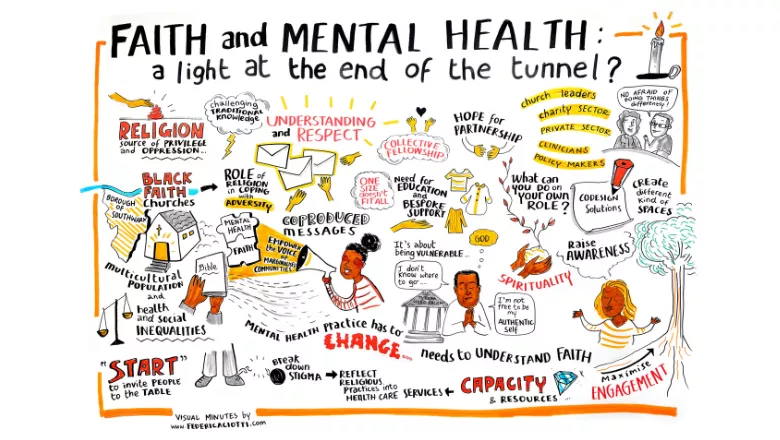
Faith & Mental health in South-East London: why ‘one size’ does not fit all
How can we start to bridge divisions between spirituality and medicine to improve mental health support in our local area?
Please note: this event has passed.
Features
King's Population Health Institute Investigator Awards
King's Population Health Investigator Projects 2025/2026

Perspectives on Religion and Spirituality in coping with Mental health (PRiSM) project
Using a participatory research approach and mixed methods, this project seeks to understand the role of spirituality and religion in coping with adversity,...

Research
Health Inequalities & Inequities Research Group
Health Inequalities & Inequities Research Group is focused on delivering interdisciplinary research on inequities in mental health in marginalised communities and across health services with an emphasis on race at the intersection of other social identities.
Population Mental Health Consortium
UK network to boost the role of research and the use of data to improve population health focused on children and young people, suicide and self-harm prevention and multiple long-term conditions.
News
PRiSM project explores religion, spirituality and mental health in Southeast London faith communities
The Perspectives on Religion and Spirituality in coping with Mental health (PRiSM) project, aims to understand the role of religion and spirituality in...
Events
Faith & Mental health in South-East London: why ‘one size’ does not fit all
How can we start to bridge divisions between spirituality and medicine to improve mental health support in our local area?
Please note: this event has passed.
Features
King's Population Health Institute Investigator Awards
King's Population Health Investigator Projects 2025/2026
Perspectives on Religion and Spirituality in coping with Mental health (PRiSM) project
Using a participatory research approach and mixed methods, this project seeks to understand the role of spirituality and religion in coping with adversity,...